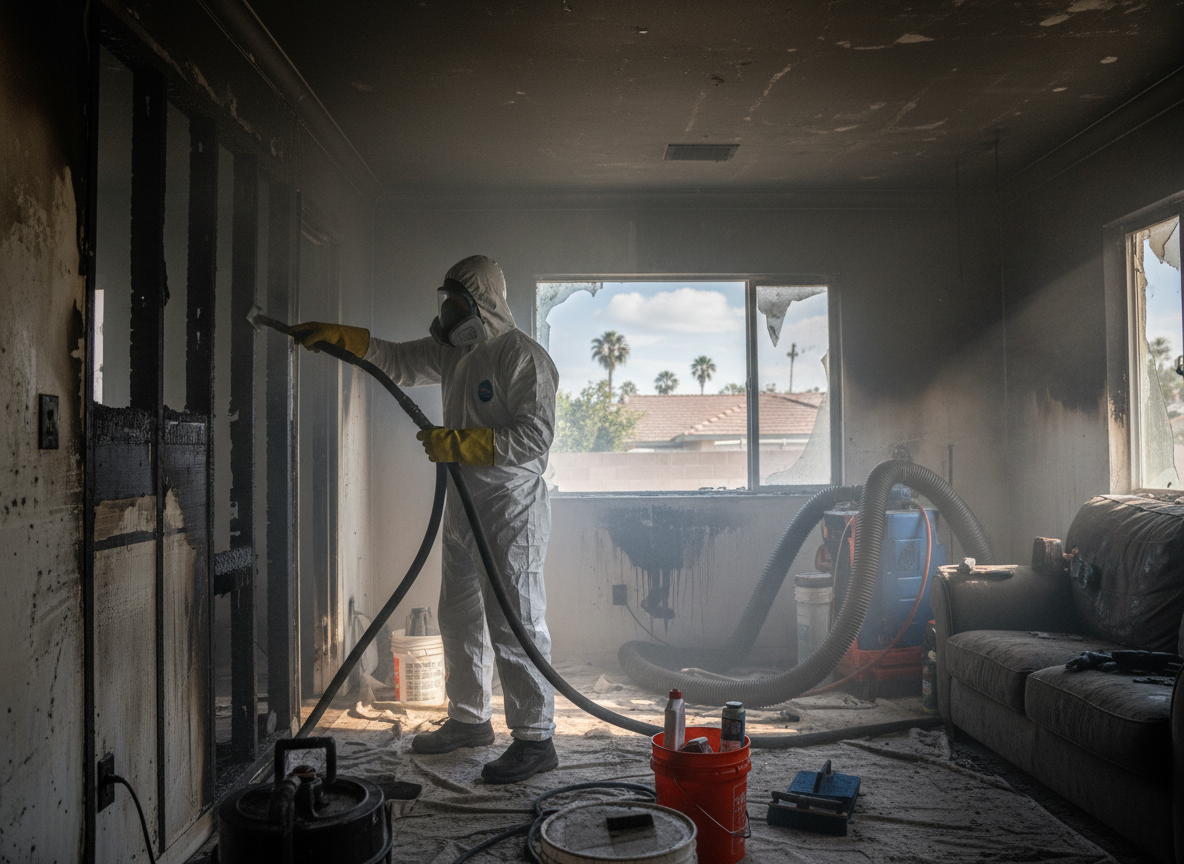
Smoke from structure fires in Sherman Oaks travels through the HVAC systems common in mid-century homes around Sherman Oaks Circle and South Sherman Oaks. Residue settles on drywall, insulation, and ductwork, requiring HEPA vacuuming followed by alkaline cleaning solutions matched to the soot type. Dry summers here accelerate particle adhesion on surfaces, while mild winters keep moisture low enough that corrosion on metal fixtures can be delayed but not prevented without prompt treatment.
Edge cases include smoke that penetrates the stucco exteriors typical of properties near Van Nuys Sherman Oaks Park, leaving invisible deposits inside wall cavities. In Encino and Studio City homes with older plaster, we often find odor pockets behind baseboards that standard ozone treatments miss. Los Angeles building codes require proper disposal of contaminated porous materials, so we document every removal step to keep the job compliant without unnecessary demolition.
Homeowners frequently overlook attic insulation after fires near the Sherman Oaks Galleria. Once smoke bonds to fiberglass, replacement is the only reliable fix. We test air quality before and after using particle counters calibrated for Los Angeles basin conditions, confirming levels return to normal before any reconstruction begins.
Technician insight
In Sherman Oaks, the thing that catches most people out with Smoke remediation is how quickly smoke travels through the shared attic spaces in 1950s-60s homes near Van Nuys Sherman Oaks Park during our dry summers, leaving residue that only shows up after the first rain.
Attic Smoke in South Sherman Oaks
A kitchen fire sent smoke upward through a two-story home near Van Nuys Sherman Oaks Park. We found heavy residue inside the fiberglass insulation and duct runs. After removing contaminated insulation and cleaning all accessible surfaces, we treated the remaining cavities and verified clearance with particle counts.
How it works
- 1
Initial Assessment
Inspect all rooms, attics, and HVAC runs in the affected Sherman Oaks property to map smoke migration paths.
- 2
Containment Setup
Isolate damaged zones with plastic barriers and negative air machines to prevent cross-contamination into clean areas.
- 3
Residue Removal
HEPA vacuum and chemically clean hard surfaces while removing porous materials that cannot be restored.
- 4
Odor Neutralization
Apply thermal fogging or hydroxyl generators to neutralize embedded smoke odors in cavities and ductwork.
- 5
Final Verification
Conduct air sampling and visual inspection to confirm the property meets post-remediation standards.
Pricing
Pricing varies with the volume of affected square footage, depth of smoke penetration into cavities, and whether HVAC cleaning is required.