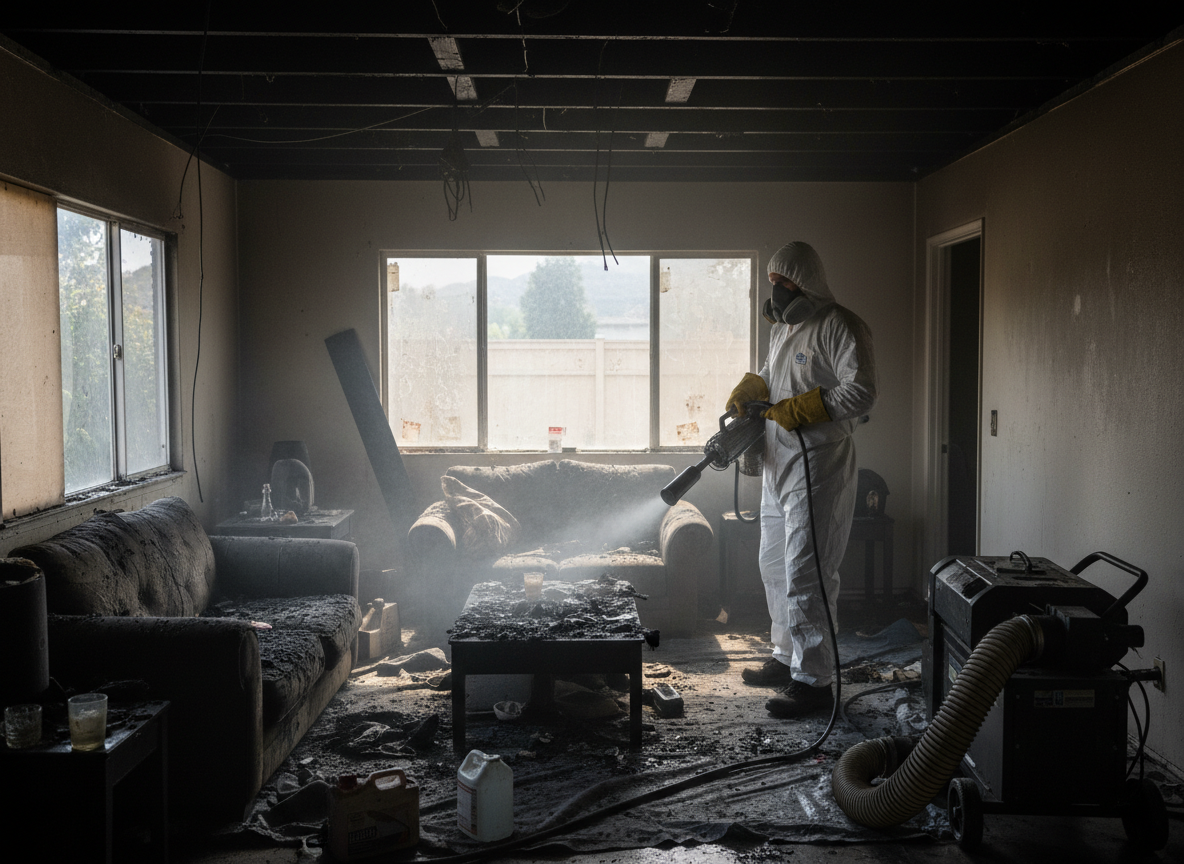
Sherman Oaks homes built in the 1950s and 1960s often feature plaster walls, hardwood floors and enclosed attics that trap smoke particles long after visible soot is removed. Warm dry summers accelerate particle settling into porous materials while mild winters reduce natural ventilation, allowing odors to linger in spaces near Van Nuys Sherman Oaks Park and Los Encinos State Historic Park. Technicians must test for hidden residues behind baseboards and in HVAC ducts common to these mid-century structures before applying hydroxyl generators or activated charcoal filtration.
Edge cases arise in South Sherman Oaks Circle properties where hillside terrain directs smoke upward into crawlspaces and under decks. Standard ozone treatments can damage certain fabrics and electronics still found in older Studio City-adjacent homes, requiring careful material assessment first. Smoke from kitchen or electrical fires frequently migrates through shared walls in multi-unit buildings near the Sherman Oaks Galleria, demanding coordinated sealing and negative air flow to prevent cross-contamination.
Los Angeles building codes require proper disposal of contaminated insulation and drywall after fire events. Skipping this step leaves residual odors that reactivate during the next Santa Ana wind event. Crews at 14425 Burbank Blvd maintain 24/7 availability to begin extraction before humidity shifts allow particles to re-embed in carpet padding or cabinetry typical throughout the neighborhood.
Technician insight
In Sherman Oaks the thing that catches most people out with odor removal after fire is how quickly dry summer air lets smoke particles sink into the original hardwood subfloors and plaster of 1950s homes near Van Nuys Sherman Oaks Park. Homeowners often stop at surface cleaning and the smell returns the first time the heat kicks on.
Kitchen fire odor in South Sherman Oaks
Smoke from a stove fire had traveled through ceiling joists into a 1962 ranch home. We found settled particles in the original insulation and along the shared wall with the neighbor. After targeted removal and hydroxyl treatment the odor was eliminated without replacing the entire ceiling.
How it works
- 1
Initial Assessment
Inspect affected rooms in Sherman Oaks homes for smoke migration paths through HVAC, attics and wall cavities.
- 2
Source Removal
Extract contaminated porous materials and clean hard surfaces before odor treatment begins.
- 3
Neutralization
Apply thermal fogging or hydroxyl processing calibrated for dry local climate and older construction materials.
- 4
Verification
Test air quality and surfaces for residual odors, repeating treatment only where needed.
Pricing
Cost depends on square footage affected, depth of smoke penetration into older Sherman Oaks construction and whether HVAC systems require full cleaning.